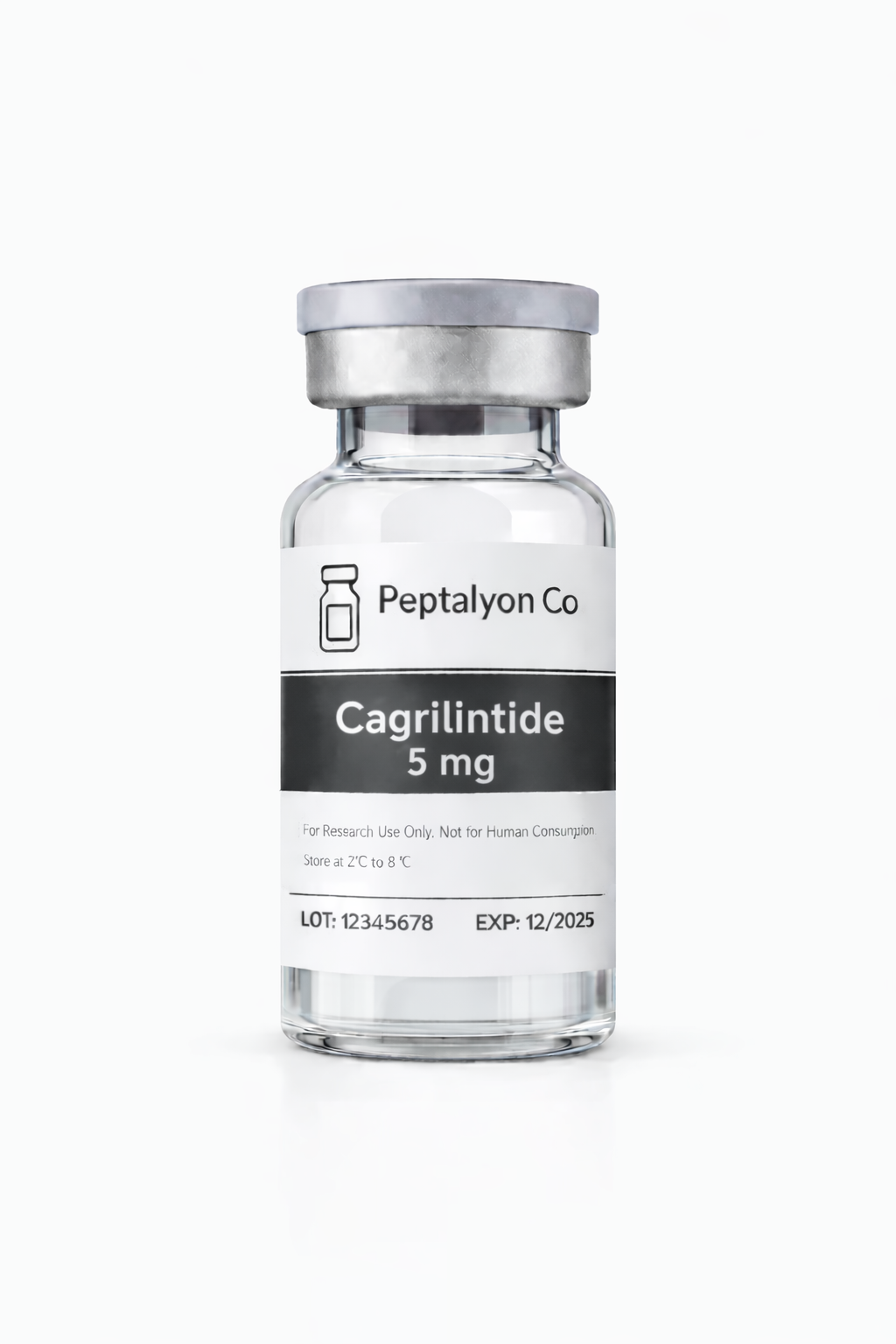
Cagrilintide
Research-Grade Amylin Analogue
$84.99
Out of stock
Product Description
Cagrilintide is a long-acting amylin analogue developed exclusively for laboratory and scientific research purposes. It is designed to mimic the activity of endogenous amylin, a hormone co-secreted with insulin from pancreatic β-cells and involved in satiety signaling, gastric emptying regulation, and energy balance pathways.
Researchers study Cagrilintide to investigate appetite-related signaling mechanisms, energy homeostasis, and metabolic regulation in controlled experimental models. Its prolonged molecular stability allows evaluation of sustained amylin receptor engagement and its interaction with complementary metabolic pathways.
This compound is not intended for human or animal use, and is not designed for therapeutic, diagnostic, or clinical applications. All use must remain strictly within qualified research settings.
Important Notice
For research purposes only. Not for human or animal use & not FDA-approved.
By purchasing, you confirm you are 21 years or older and a qualified researcher.
Long-acting amylin analogue engineered for sustained receptor engagement
High purity (≥98%) to support reproducible experimental outcomes
Widely studied in appetite regulation and metabolic research models
Relevant for combination pathway research, including incretin signaling
Batch verified for identity, purity, and structural integrity
Appetite & Satiety Signaling
Cagrilintide is studied for its interaction with amylin receptor pathways involved in satiety signaling within the central nervous system, particularly regions associated with appetite regulation.
Weight Regulation & Energy Balance
Research models explore how sustained amylin receptor activation may influence energy intake, energy expenditure, and body composition-related pathways under controlled conditions.
Gastric Emptying Dynamics
Experimental studies investigate the role of amylin analogues in gastric emptying regulation, providing insight into postprandial metabolic signaling mechanisms.
Combination Pathway Research
Cagrilintide is frequently examined alongside GLP-1 receptor pathway compounds to study additive or complementary effects on appetite and metabolic signaling without clinical application.
Gabery S et al. (2020). Cagrilintide, a Long-Acting Amylin Analogue: CNS Target Engagement.
Diabetes, Obesity and Metabolism
https://insight.jci.org/articles/view/133429/sd/1Nauck MA et al. (2021). Weight-Loss Effects of Cagrilintide in Obesity Research.
The Lancet
https://www.thelancet.com/journals/lancet/article/PIIS0140-6736%2821%2901751-7/fulltextHay DL et al. (2015). Amylin Receptor Pharmacology and Gastric Emptying.
British Journal of Pharmacology
https://docslib.org/doc/978634/amylin-pharmacology-physiology-and-clinical-potentialFriedrichsen M et al. (2021). Cagrilintide Plus Semaglutide: Combination Therapy Research.