
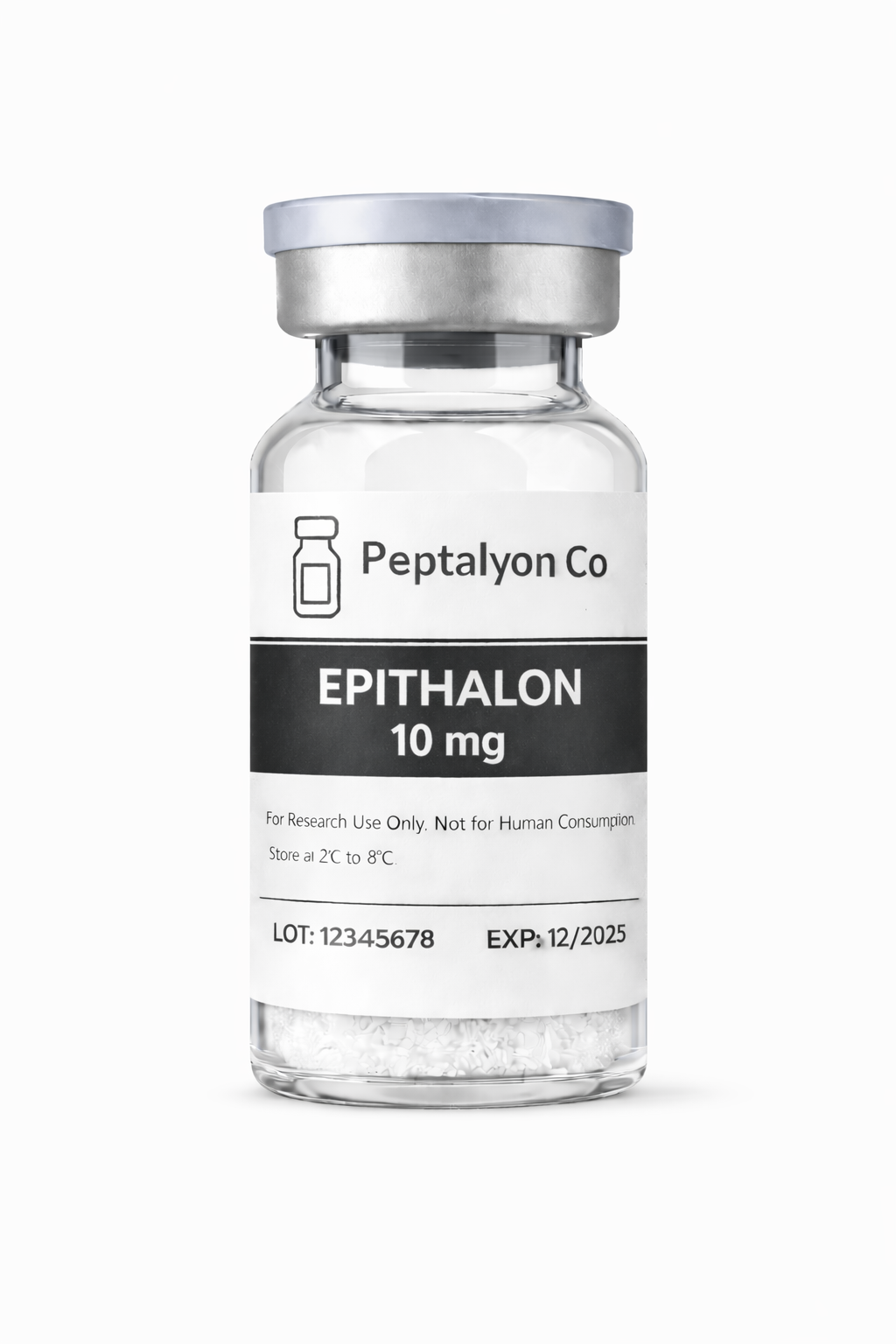
Epithalon
Telomere & Longevity Research
$74.99
Out of stock
Product Description
Epithalon (also known as Epitalon or Epithalamin) is a synthetic tetrapeptide (Ala-Glu-Asp-Gly) derived from the naturally occurring pineal peptide complex Epithalamin. It has been studied extensively in Russian biogerontology research for its involvement in telomere biology, cellular aging pathways, and neuroendocrine regulation.
Researchers investigate Epithalon to explore telomerase activation, telomere length maintenance, oxidative stress modulation, circadian rhythm–related gene expression, and age-associated cellular changes in controlled cellular and animal models. Its small molecular size and well-defined sequence make it a frequently referenced compound in longevity and aging-related research frameworks.
This compound is not intended for human or animal use, and is not designed for therapeutic, diagnostic, or clinical applications. All use must remain strictly within qualified research settings.
Important Notice
For research purposes only. Not for human or animal use & not FDA-approved.
By purchasing, you confirm you are 21 years of age or older and a qualified researcher.
Well-characterized tetrapeptide with decades of biogerontology research history
Referenced for telomerase-related pathway studies in human cell cultures
Relevant for oxidative stress and cellular senescence research models
Investigated for neuroendocrine and circadian rhythm–associated signaling
High purity (≥98%) to support reproducible experimental outcomes
Batch verified for identity, purity, and structural consistency
Telomere Biology & Cellular Aging
Epithalon is studied for its interaction with telomerase activity and telomere length regulation, contributing to research on cellular replicative capacity and aging-related genomic stability in vitro.
Oxidative Stress & Cellular Resilience
Research models explore how Epithalon may influence antioxidant enzyme activity and oxidative stress markers, supporting investigations into cellular defense mechanisms during aging.
Neuroendocrine & Circadian Rhythm Signaling
Epithalon is examined for its role in pineal gland–associated signaling and melatonin-related pathways, making it relevant for circadian rhythm and sleep-wake cycle research.
Longevity & Age-Associated Models
Animal studies investigate Epithalon within aging and lifespan research frameworks, including reproductive and neuroendocrine function in advanced age models.
Khavinson V et al. (2003). Epithalon induces telomerase activity and telomere elongation in human somatic cells.
Bulletin of Experimental Biology and Medicine
https://link.springer.com/article/10.1023/A%3A1025493705728Anisimov VN et al. (2001). Effect of Epithalon on antioxidant enzymes in aging rats.
Biogerontology
https://link.springer.com/article/10.1023/A%3A1025114230714Khavinson V et al. (2002). Pineal peptides and melatonin regulation.
Neuroendocrinology Letters
https://www.nel.edu/Neuro-endocrinology-letters-23-Suppl-3/Anisimov VN et al. (2000). Epithalon increases lifespan in rodent models.
Bulletin of Experimental Biology and Medicine
https://www.sciencedirect.com/science/article/abs/pii/S0047637400002177