
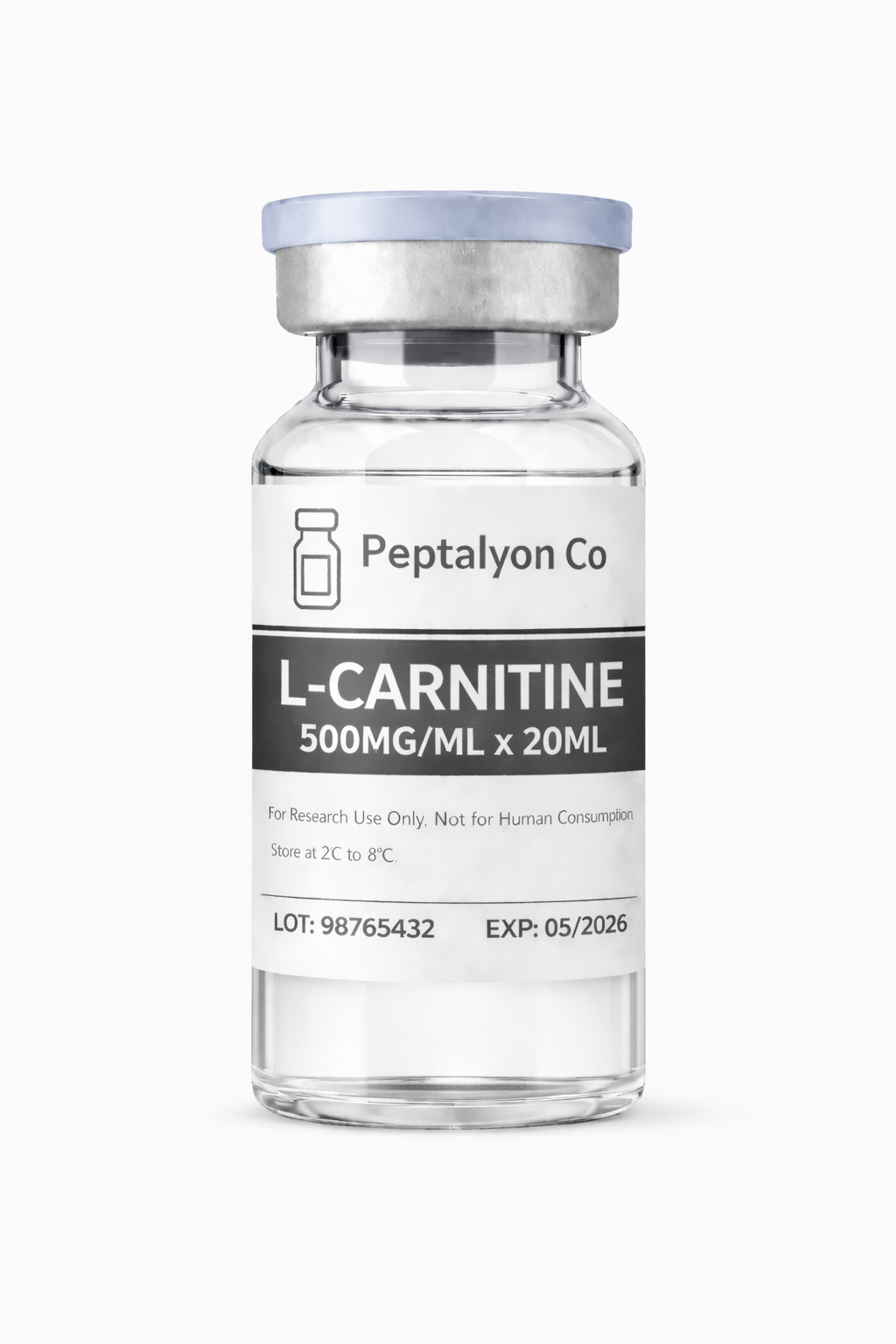
L-Carnitine
$30.00
Out of stock
Product Description
Description:
L-Carnitine is a naturally occurring quaternary ammonium compound widely studied in laboratory settings for its role in fatty acid transport and cellular energy metabolism. It is involved in the movement of long-chain fatty acids into the mitochondria, where they may be utilized in energy production pathways.
Because of its role in metabolic function, mitochondrial activity, and energy regulation, L-Carnitine is commonly used in research related to cellular metabolism, exercise physiology, and biochemical performance models.
This product contains L-Carnitine at a concentration of 500 mg/ml in a 20 ml solution, intended strictly for controlled laboratory and research applications.
Specifications:
Compound: L-Carnitine
Concentration: 500 mg/ml
Volume: 20 ml
Form: Solution
Appearance: Clear liquid
Storage: Store according to laboratory protocol in a cool, dry environment away from direct light
Intended Use: For research use only
Important Notice
For research purposes only. Not for human or animal use & not FDA-approved.
By purchasing, you confirm you are 21 years of age or older and a qualified researcher.
L-Carnitine is widely utilized in laboratory research due to its essential role in cellular energy production and metabolic function. Its involvement in mitochondrial activity makes it a key compound for studying how cells generate and utilize energy.
1. Essential for Fatty Acid Transport
L-Carnitine facilitates the transport of long-chain fatty acids into the mitochondria, where they are studied in energy production pathways. This makes it a core compound in metabolic research.
2. Key Role in Mitochondrial Function
Because mitochondria are central to cellular energy, L-Carnitine is frequently used in studies examining mitochondrial efficiency, dysfunction, and overall cellular performance.
3. Energy Metabolism Research
Researchers use L-Carnitine to explore how cells convert nutrients into usable energy, especially in models involving metabolic stress or energy demand.
4. Widely Studied in Performance & Recovery Models
L-Carnitine is often included in laboratory studies focused on exercise physiology, endurance models, and recovery-related biochemical pathways.
5. Supports Investigation of Metabolic Pathways
Its role in lipid metabolism makes L-Carnitine valuable for analyzing how fats are processed and utilized at the cellular level.
Cellular energy metabolism
Fatty acid transport
Mitochondrial function
Exercise and performance research
Metabolic pathway analysis
Flanagan, J. L., Simmons, P. A., Vehige, J., Willcox, M. D., & Garrett, Q. (2010).
Role of carnitine in disease.
Nutrition & Metabolism, 7(30).
https://doi.org/10.1186/1743-7075-7-30
Longo, N., Frigeni, M., & Pasquali, M. (2016).
Carnitine transport and fatty acid oxidation.
Biochimica et Biophysica Acta (BBA) - Molecular Cell Research, 1863(10), 2422–2435.
https://doi.org/10.1016/j.bbamcr.2016.01.023