
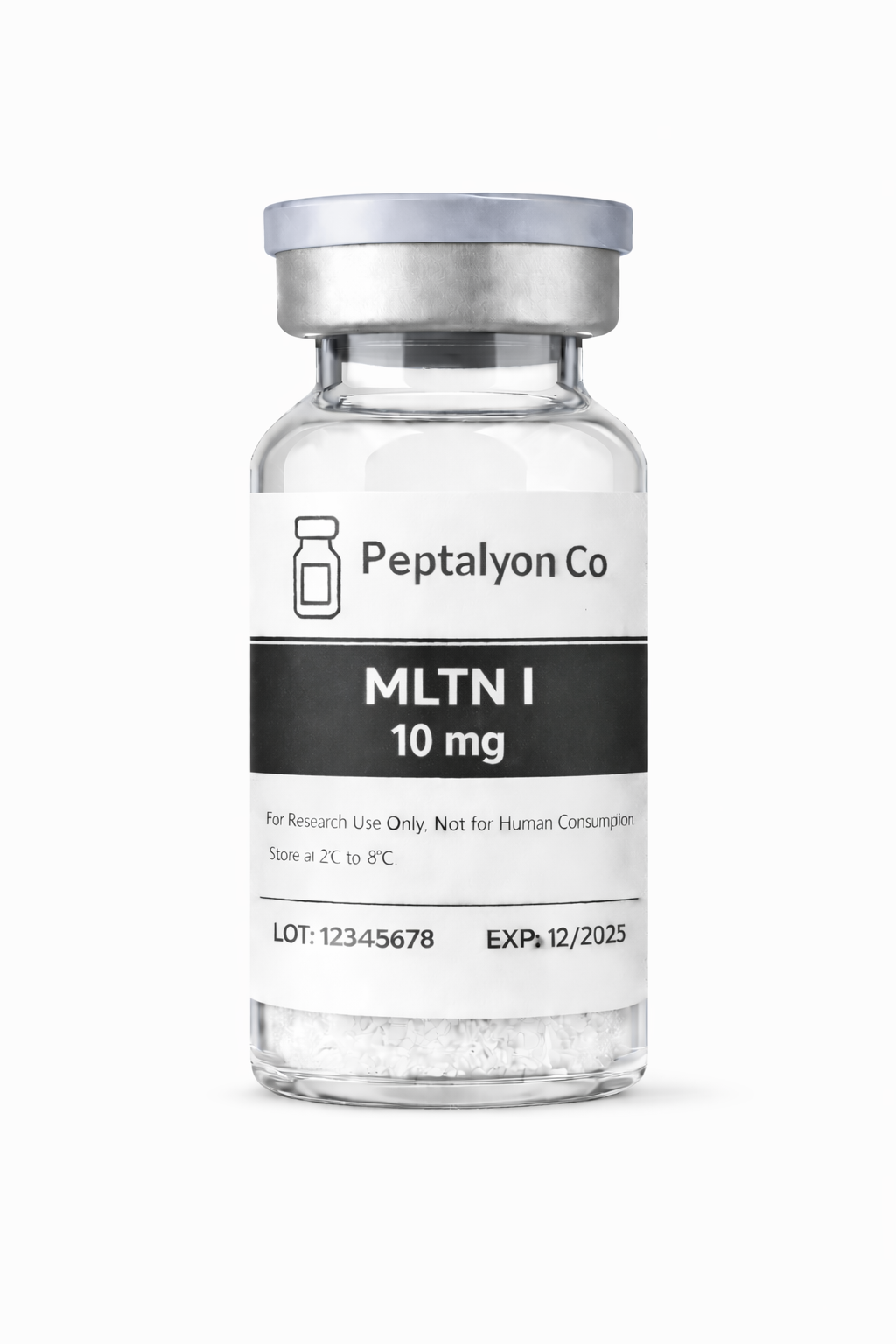
MLTN I
Melanocortin & Photobiology Research
$20.00
Out of stock
Product Description
MLTN I (also known as Afamelanotide or NDP-MSH) is a synthetic analogue of alpha-melanocyte-stimulating hormone (α-MSH) engineered for increased stability and receptor selectivity compared to the endogenous peptide. In research literature, it is studied primarily for its interaction with melanocortin receptors, particularly MC1R, and its role in melanogenesis and photoprotective signaling pathways.
Researchers utilize MLTN I to investigate skin pigmentation mechanisms, ultraviolet (UV) response biology, DNA damage and repair pathways, and inflammatory modulation in controlled cellular, animal, and human research settings. Its prolonged activity profile and defined receptor targeting make it a commonly referenced compound in dermatology and photobiology research models.
This compound is not intended for human or animal use, and is not designed for therapeutic, diagnostic, or clinical applications. All use must remain strictly within qualified research settings.
Important Notice
For research purposes only. Not for human or animal use & not FDA-approved.
By purchasing, you confirm you are 21 years of age or older and a qualified researcher.
Potent α-MSH analogue with high selectivity for melanocortin receptors
Enhanced metabolic stability compared to native α-MSH
Widely referenced in pigmentation and UV-response research literature
Relevant for inflammatory and immune signaling pathway studies
High purity (≥98%) to support reproducible experimental outcomes
Batch verified for identity, purity, and structural integrity
Melanogenesis & Pigmentation Pathways
MLTN I is studied for its role in melanin synthesis signaling, particularly through activation of MC1R-mediated pathways in melanocytes.
Photoprotection & UV Response Biology
Research models explore how melanocortin signaling may influence cellular responses to ultraviolet radiation, including adaptive pigmentation and photoprotective mechanisms.
Inflammatory & Immune Modulation
Studies investigate interactions between MLTN I and melanocortin-mediated anti-inflammatory signaling pathways, contributing to broader immune response research.
DNA Damage & Repair Mechanisms
Experimental data examine potential associations between melanocortin receptor activation and DNA repair processes, including nucleotide excision repair following UV exposure.
Dorr RT et al. (2004). Pharmacology of Melanotan I (Afamelanotide) and Skin Pigmentation. Annals of the New York Academy of Sciences.
https://link.springer.com/content/pdf/10.1007/s40262-016-0501-5.pdfKadekaro AL et al. (2010). Melanocortin and Photoprotection: Mechanisms of DNA Repair Enhancement. Pigment Cell & Melanoma Research.
https://onlinelibrary.wiley.com/doi/pdf/10.1111/j.1755-148X.2010.00679.xGetting SJ (2006). Melanocortin Peptides and Their Role in Inflammation. Pharmacology & Therapeutics.
https://www.sciencedirect.com/science/article/pii/S0163725805002809Abdel-Malek ZA et al. (2009). MC1R Activation and Nucleotide Excision Repair After UV Exposure. PNAS.
https://onlinelibrary.wiley.com/doi/pdf/10.1111/j.1755-148X.2010.00679.x