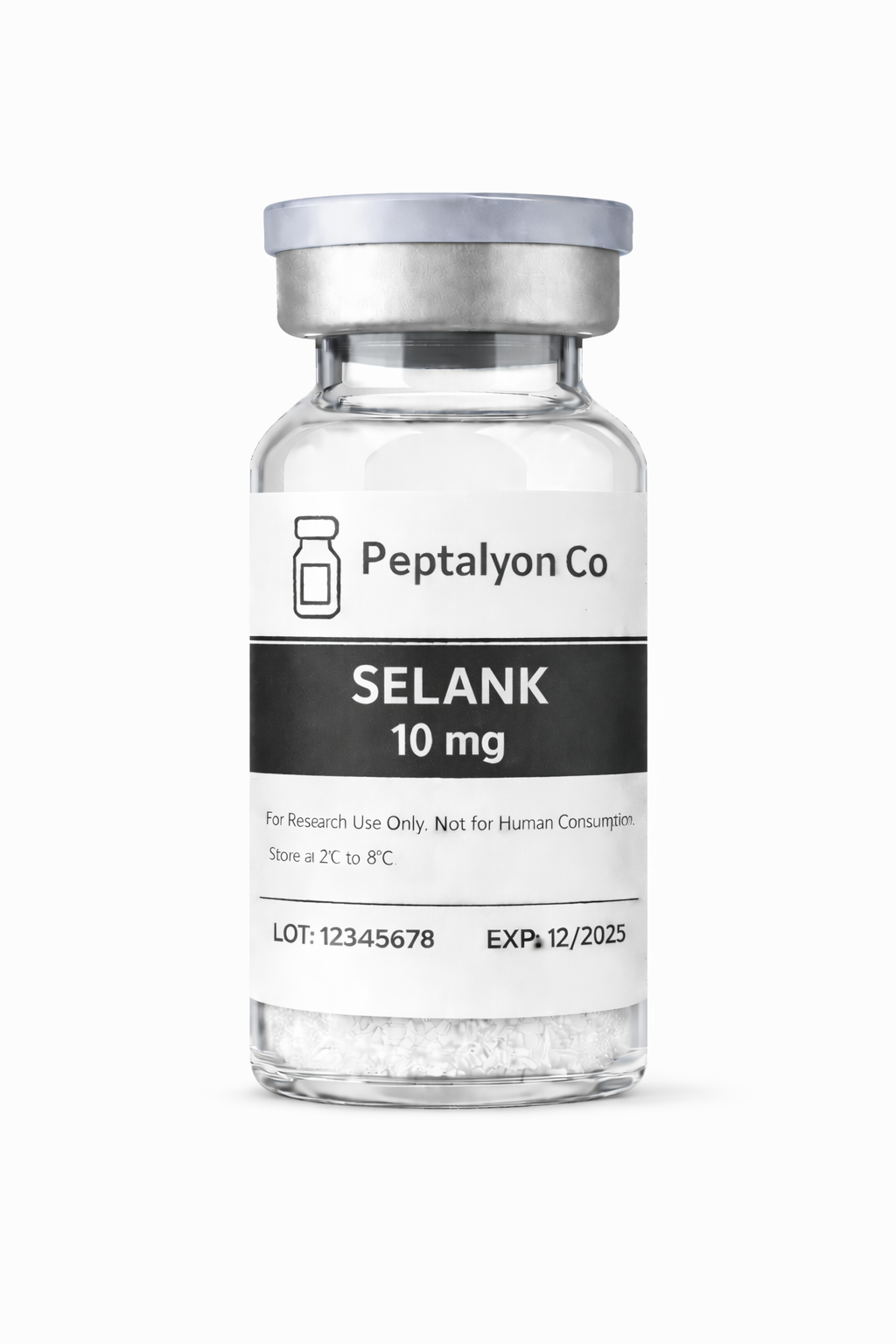
Selank
Neuroactive Peptide Analog Research
$30.00
Out of stock
Product Description
Selank is a synthetic peptide analogue of tuftsin, an endogenous immunomodulatory tetrapeptide, developed for laboratory and scientific research purposes. In the scientific literature, Selank has been studied primarily within neuroscience and immunology research frameworks for its involvement in neurotransmitter regulation, stress-response signaling, and immune–neural interaction pathways.
Researchers investigate Selank to explore serotonergic and dopaminergic signaling, gene expression related to stress adaptation, hypothalamic–pituitary–adrenal (HPA) axis modulation, and cytokine-associated immune pathways in controlled experimental models. Its structural stability and reproducible profile make it a useful tool for neuropeptide signaling and systems-biology research.
This compound is not intended for human or animal use, and is not designed for therapeutic, diagnostic, or clinical applications. All use must remain strictly within qualified research settings.
Important Notice
For research purposes only. Not for human or animal use & not FDA-approved.
By purchasing, you confirm you are 21 years of age or older and a qualified researcher.
Tuftsin-derived peptide analogue supporting neuro-immune research models
Referenced in peer-reviewed neuroscience and immunology literature
Relevant for stress-response and neurotransmission pathway studies
Stable formulation suitable for short- and long-term experimental protocols
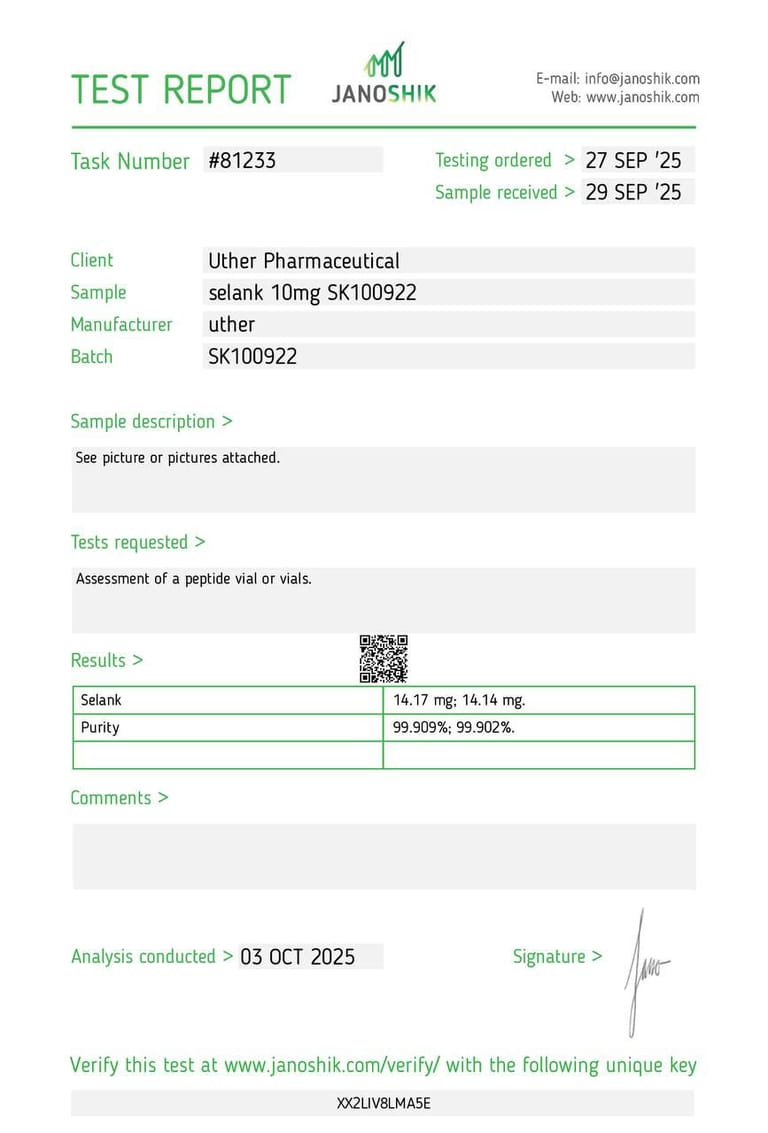
High purity to support reproducible experimental outcomes
Consistent batch quality control for cross-study comparability
Neurotransmission & Cognitive Pathways
Selank is studied for its interaction with serotonergic and dopaminergic signaling systems, contributing to research on learning, memory, attention, and cognitive processing mechanisms in experimental models.
Stress-Response & HPA Axis Signaling
Preclinical studies examine Selank-associated modulation of stress-related gene expression and HPA-axis–linked pathways, supporting investigations into adaptive stress responses.
Neuro-Immune Interaction & Cytokine Regulation
Research explores how Selank may influence immune signaling and cytokine-associated gene expression, linking neuropeptide activity with immune system regulation.
Metabolic & Neuroendocrine Signaling
Additional studies investigate Selank within broader neuroendocrine and systemic regulation frameworks, including energy balance and stress-related metabolic pathways.
Semenova TP et al. (2007). Effect of Selank on cognitive processes after damage to the cerebral catecholamine system during early ontogeny.
Bulletin of Experimental Biology and Medicine, 144, 689–691.
https://link.springer.com/article/10.1007/s10517-007-0406-2Volkova A et al. (2016). Selank administration affects gene expression involved in neurotransmission in the rat frontal cortex.
Frontiers in Pharmacology, 7:31.
https://www.frontiersin.org/journals/pharmacology/articles/10.3389/fphar.2016.00031/fullMjasoedov N et al. (2024). Selank peptide–induced gene expression changes in the rat brain after acute restraint stress (RNA-Seq).
Biology Bulletin Reviews.
https://link.springer.com/article/10.1134/S2635167624601335Kolomin T et al. (2011). Expression of inflammation-related genes in mouse spleen under tuftsin analogue Selank action.
Regulatory Peptides, 170, 18–23.
https://www.sciencedirect.com/science/article/pii/S0167011511000863Myasoedov NF et al. (2017). Effect of Selank on functional state of rat hepatocytes under acute restraint stress.
Bulletin of Experimental Biology and Medicine, 163, 715–719.
https://link.springer.com/article/10.1007/s10517-017-3817-8