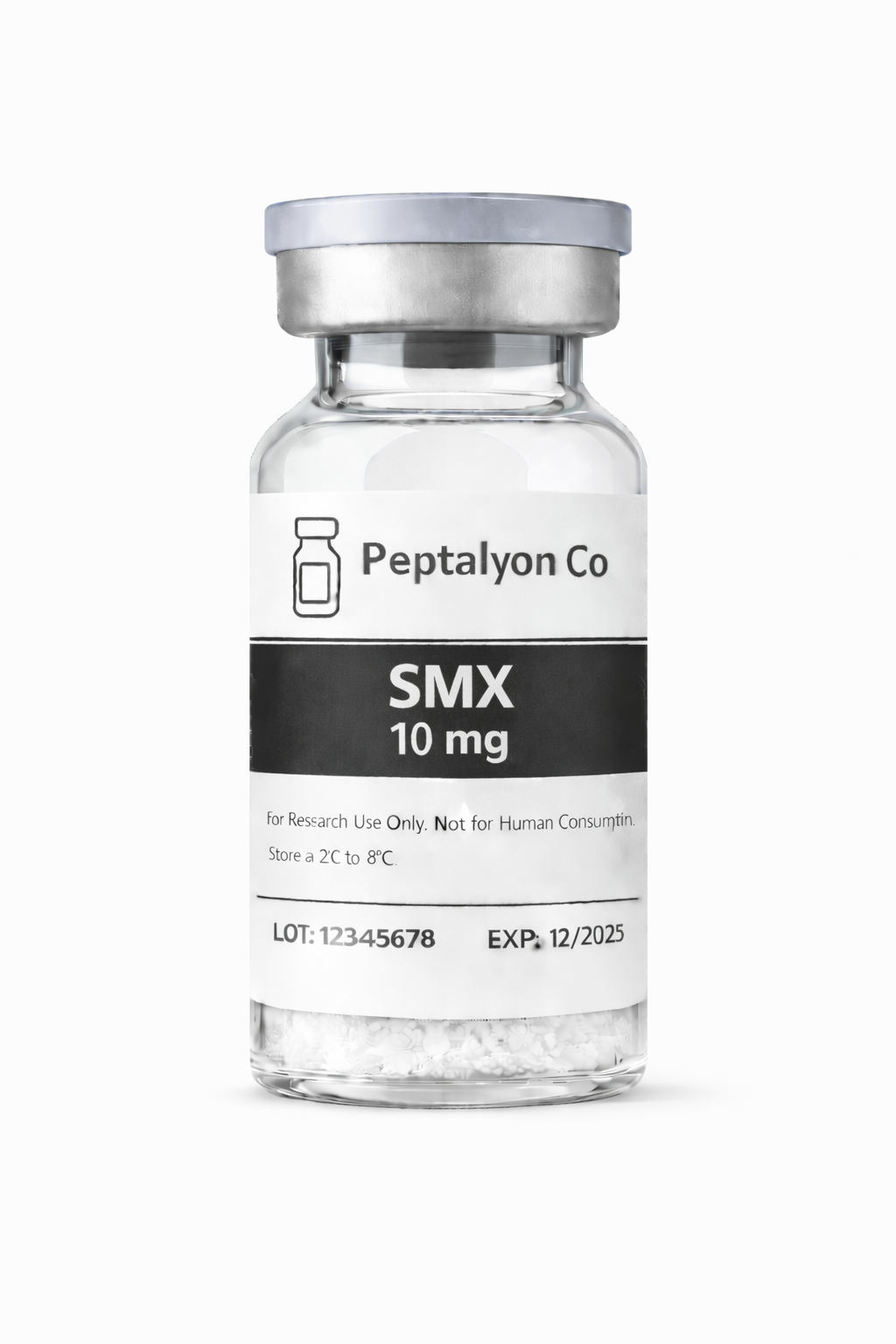
Semax
Neuroprotection & Cognitive Research
$39.00
Out of stock
Product Description
Semax is a synthetic analogue of the adrenocorticotropic hormone fragment ACTH(4–10), engineered to enhance stability and biological persistence for laboratory research applications. In the scientific literature, Semax has been studied extensively—particularly in Russia and Eastern Europe—for its involvement in neuroprotective signaling, neurotrophic regulation, and cognitive-related pathways.
Researchers investigate Semax to explore brain-derived neurotrophic factor (BDNF) regulation, monoaminergic signaling (dopaminergic and serotonergic pathways), neuroplasticity, and cellular response to ischemic stress in controlled experimental models. Its documented ability to cross the blood–brain barrier makes it a valuable tool for studying central nervous system signaling mechanisms related to learning, memory, and neural resilience.
This compound is not intended for human or animal use, and is not designed for therapeutic, diagnostic, or clinical applications. All use must remain strictly within qualified research settings.
Important Notice
For research purposes only. Not for human or animal use & not FDA-approved.
By purchasing, you confirm you are 21 years of age or older and a qualified researcher.
Stable ACTH(4–10) analogue engineered for resistance to enzymatic degradation
Referenced for neurotrophic pathway research, including BDNF-related signaling
Relevant across multiple CNS research domains, including ischemia and neuroinflammation
Minimal endocrine activity compared to full-length ACTH in research models
High purity (≥98%) to support reproducible experimental outcomes
Batch verified for identity, purity, and structural integrity
Neuroprotection & Ischemic Stress Response
Semax is studied for its interaction with neuronal survival pathways and cerebral blood flow regulation, supporting research into cellular response mechanisms following ischemic or hypoxic stress in experimental models.
Cognition, Learning & Memory Pathways
Research investigates how Semax may influence BDNF expression and synaptic plasticity-related signaling, contributing to studies of learning and memory mechanisms in preclinical settings.
Neuroinflammatory & Genomic Regulation
Experimental studies examine Semax-associated gene expression modulation related to neurodegenerative and inflammatory signaling pathways, providing insight into CNS stress responses.
Monoaminergic & Stress-Related Signaling
Semax is also examined for its interaction with dopaminergic and serotonergic systems, contributing to broader investigations into neurochemical signaling and stress-related pathways.
Povarnina, P. Y., et al. (2020). Semax improves cerebral blood flow and protects against ischemia-induced damage. Neuropeptides, 83, 102114. https://doi.org/10.1016/j.npep.2020.102114
Andreeva LA et al. (2002). Effects of Semax on BDNF Expression and Cognitive Function. Neuroscience Letters.
https://link.springer.com/content/pdf/10.1023/A%3A1025177812262.pdfShadrina, M. I., et al. (2014). Genomic effects of Semax on genes linked to neurodegenerative pathways. BMC Genomics, 15, 228.
https://doi.org/10.1186/1471-2164-15-228Kubatiev AA et al. (2005). Influence of Semax on Dopamine and Serotonin Metabolism. Neuroscience & Behavioral Physiology.
https://link.springer.com/article/10.1007/s11064-005-8826-8