
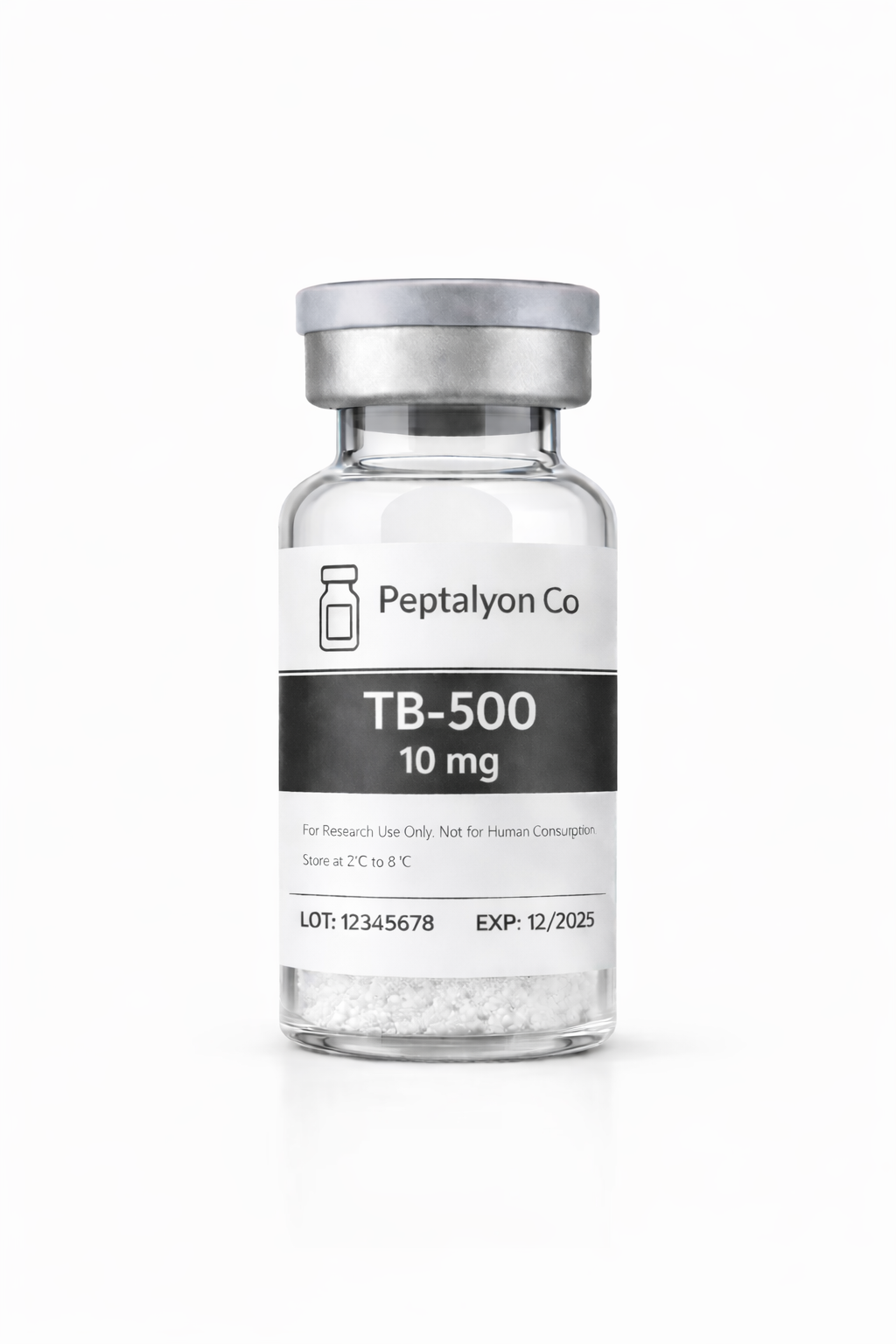
TB-500
Cell Migration & Tissue Repair Research
$25.00
Out of stock
Product Description
TB-500 is a synthetic peptide fragment derived from Thymosin Beta-4 (Tβ4), a naturally occurring protein involved in actin regulation, cell migration, and cytoskeletal organization. In research literature, TB-500 is examined for its role in angiogenic signaling, wound-healing pathways, and tissue regeneration mechanisms in preclinical models.
Researchers study TB-500 to investigate fibroblast and endothelial cell migration, muscle and connective tissue response following injury, and post-injury recovery signaling pathways under controlled laboratory conditions. Its relatively small molecular size and stability make it a commonly referenced compound for systemic tissue repair research models.
This compound is not intended for human or animal use, and is not designed for therapeutic, diagnostic, or clinical applications. All use must remain strictly within qualified research settings.
Important Notice
For research purposes only. Not for human or animal use & not FDA-approved.
By purchasing, you confirm you are 21 years of age or older and a qualified researcher.
Derived from endogenous Thymosin Beta-4, supporting biologically relevant research models
High purity (≥98%) to support reproducible experimental outcomes
Low molecular weight peptide suitable for systemic research applications
Widely referenced in studies involving cell migration and vascular biology
Batch verified for identity, purity, and structural integrity
Cell Migration & Wound-Healing Pathways
Preclinical studies investigate TB-500 for its involvement in fibroblast and keratinocyte migration, contributing to research on wound closure dynamics and tissue remodeling mechanisms.
Angiogenesis & Vascular Signaling
Research models explore how TB-500 may influence endothelial cell activation and angiogenic signaling pathways, supporting studies of vascular growth and perfusion following tissue injury.
Muscle, Tendon & Connective Tissue Response
TB-500 is examined in models of muscle fiber regeneration and connective tissue repair, including tendon and ligament response following mechanical or ischemic injury.
Inflammatory Modulation in Tissue Repair
Experimental data explore interactions between TB-500 and inflammatory signaling pathways, providing insight into how inflammatory environments may influence tissue recovery processes.
Malinda KM et al. (1999). Thymosin Beta-4 Accelerates Wound Healing. Journal of Investigative Dermatology.
https://www.scirp.org/reference/referencespapers?referenceid=1316929Goldstein AL et al. (2012). Role of Tβ4 in Angiogenesis and Endothelial Cell Migration. Annals of the New York Academy of Sciences.
https://link.springer.com/content/pdf/10.1007/978-1-4757-9185-3_18Bock-Marquette I et al. (2004). Tβ4 Induces Adult Epicardial Progenitor Mobilization and Repair. Nature.
https://www.nature.com/articles/nature05383.pdfSosne G et al. (2007). Anti-Inflammatory and Cytoprotective Effects of Tβ4 in Ocular Models. Experimental Eye Research.
https://www.scirp.org/reference/referencespapers?referenceid=1316954