
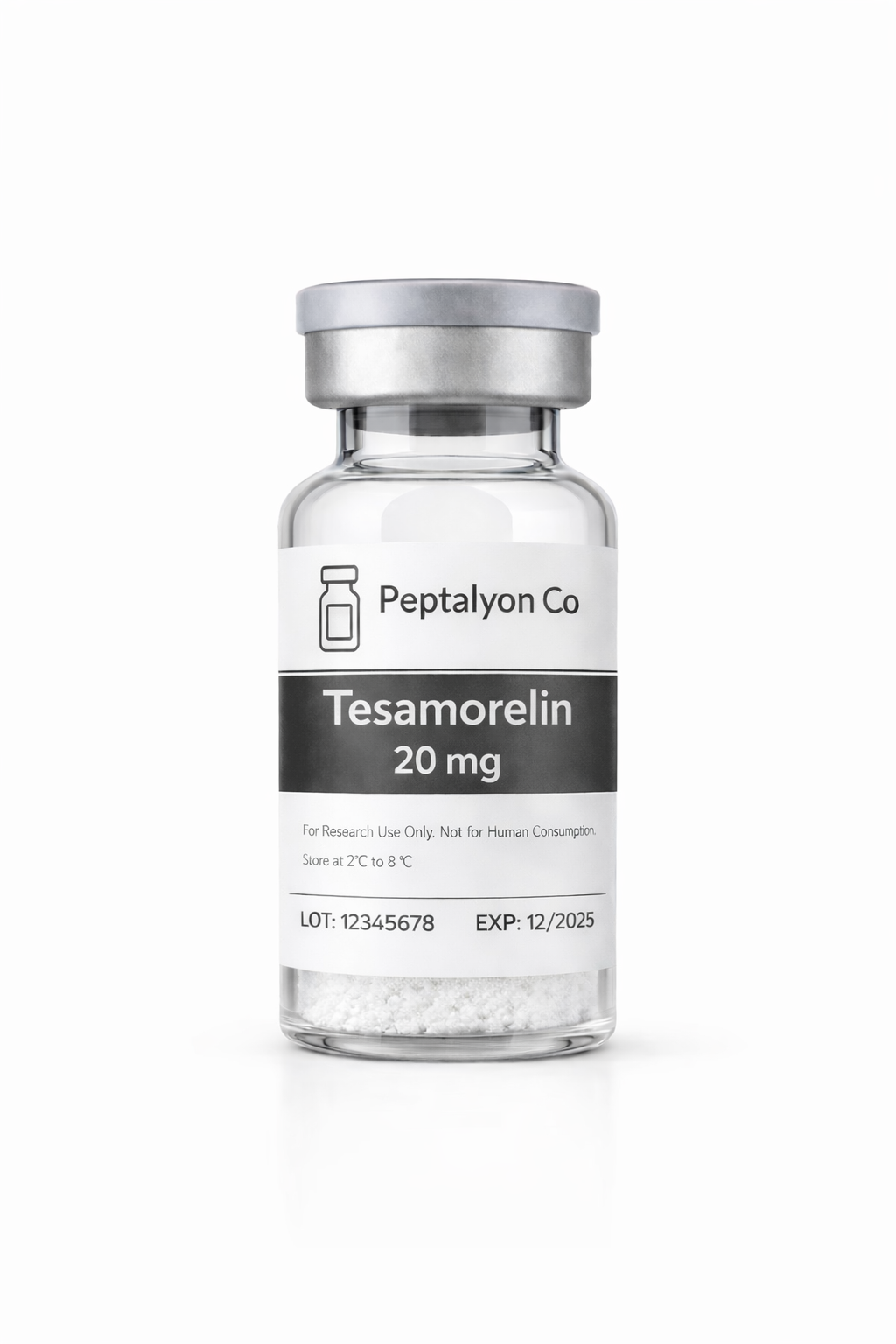
Tesamorelin
GH Axis & Lipid Metabolism Research
$109.99
Out of stock
Product Description
Tesamorelin (scientific designation TH9507) is a synthetic growth hormone–releasing hormone (GHRH) analogue developed for laboratory and scientific research purposes. It selectively interacts with GHRH receptors in the anterior pituitary, enabling investigation of physiologic growth hormone (GH) secretion patterns and downstream IGF-1–related signaling pathways in controlled research models.
In the scientific literature, tesamorelin has been examined for its role in GH/IGF-1 axis regulation, visceral adipose tissue biology, lipid metabolism, and body composition–related pathways. Its structural modifications confer increased resistance to enzymatic degradation, making it a well-characterized tool for endocrine and metabolic research.
This compound is not intended for human or animal use, and is not designed for therapeutic, diagnostic, or clinical applications. All use must remain strictly within qualified research settings.
Important Notice
For research purposes only. Not for human or animal use & not FDA-approved.
By purchasing, you confirm you are 21 years of age or older and a qualified researcher.
Highly specific GHRH analogue enabling study of physiologic GH secretion dynamics
Well-documented relevance in GH/IGF-1 axis and lipid metabolism research literature
Enzyme-resistant molecular design supporting extended activity in experimental models
High purity (≥98%) to support reproducible experimental outcomes
Batch verified for identity, purity, and structural integrity
GH/IGF-1 Axis Regulation
Tesamorelin is studied for its interaction with endogenous GH secretion pathways, enabling research into IGF-1 signaling, pulsatile GH dynamics, and endocrine feedback mechanisms in controlled models.
Visceral Adipose Tissue & Lipid Metabolism
Research examines how modulation of the GH axis may influence visceral fat biology, triglyceride metabolism, and lipid-associated signaling pathways, particularly in metabolic research populations.
Body Composition & Lean Mass Pathways
Scientific studies explore relationships between GH signaling and body composition–related mechanisms, including lean mass maintenance and fat redistribution in metabolic research settings.
Insulin Sensitivity & Metabolic Regulation
Some research models evaluate secondary interactions between GH axis modulation and insulin sensitivity markers, contributing to broader investigations into metabolic homeostasis.
Falutz J et al. (2010). Effects of Tesamorelin on Abdominal Fat and IGF-1 Levels.
Journal of Clinical Endocrinology & Metabolism
https://academic.oup.com/jcem/article-abstract/95/9/4291/2835394Stanley TL et al. (2019). Tesamorelin Reduces Visceral Fat in Obesity and HIV-Associated Lipodystrophy Research Models.
The Lancet Diabetes & Endocrinology
https://www.natap.org/2019/HIV/PIIS2352301819303315.pdfStanley TL et al. (2014). Changes in Body Composition with Tesamorelin.
Journal of Clinical Endocrinology & Metabolism
https://jamanetwork.com/journals/jama/fullarticle/1889139Falutz J et al. (2011). Metabolic Effects of Tesamorelin and Growth Hormone Axis Modulation.
AIDS
https://peptideinfo.org/tesamorelin